What would a Roman legionary have heard before seeing the enemy?
Not the clang of weapons or a battle cry. First, a sound would reach him—low, piercing, and devoid of anything human. It vibrated in the chest, swelling like the roar of a colossal beast breaking its chains. This sound heralded not just a battle, but something frightening and irrational. For the Romans, it was the voice of chaos itself, the voice of the barbarian world beyond the Empire's borders.
Its source was the carnyx—the ritual war horn of the ancient Celts. This was not an instrument for giving clear signals. It was a weapon of psychological warfare, a symbol of the druids' power, a sacred object whose voice, it was believed, could summon gods and terrify any mortal.
But the most amazing thing is that we still don't know everything about the carnyx. We piece together its history bit by bit, literally from fragments dug up by archaeologists. It's an incredible detective story where each new find overturns assumptions.
Not the clang of weapons or a battle cry. First, a sound would reach him—low, piercing, and devoid of anything human. It vibrated in the chest, swelling like the roar of a colossal beast breaking its chains. This sound heralded not just a battle, but something frightening and irrational. For the Romans, it was the voice of chaos itself, the voice of the barbarian world beyond the Empire's borders.
Its source was the carnyx—the ritual war horn of the ancient Celts. This was not an instrument for giving clear signals. It was a weapon of psychological warfare, a symbol of the druids' power, a sacred object whose voice, it was believed, could summon gods and terrify any mortal.
But the most amazing thing is that we still don't know everything about the carnyx. We piece together its history bit by bit, literally from fragments dug up by archaeologists. It's an incredible detective story where each new find overturns assumptions.
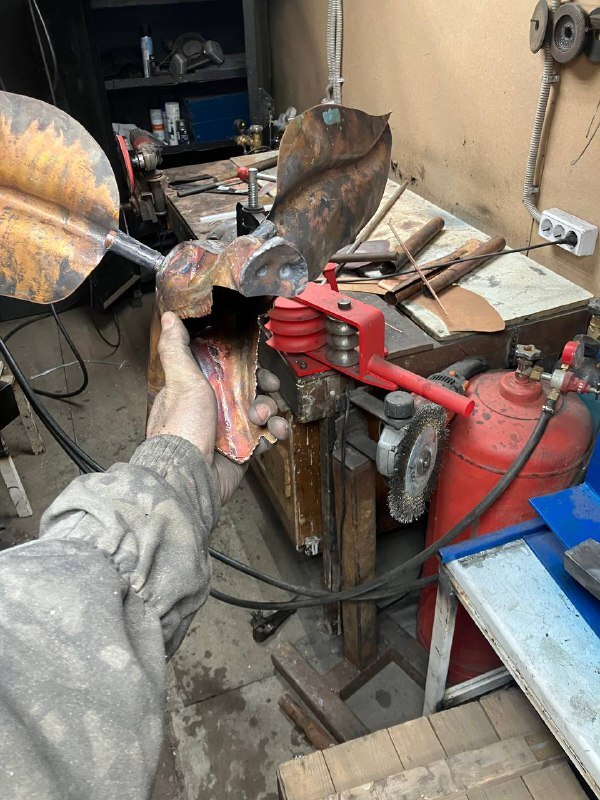
What is a Carnyx? Meaning and History
The Celtic battle trumpet, the carnyx, is a complex wind instrument, typically with a bell in the shape of an animal's head (boar, wolf, snake).
Its primary purpose was not musical, but psychological and ritual: its deafening, inhuman sound was used to intimidate the enemy and boost morale before an attack.
Made from organic materials (wood, leather) and thin bronze, it rarely survives in the ground.
Until 2025, only a few dozen fragments were known worldwide, and just one major find of several specimens in one place.
Before the Norfolk discovery, scientists knew about carnyxes mainly from fragments and images on coins or the Gundestrup cauldron. Complete specimens are incredibly rare. Until 2004, only five fragmented finds were known. The breakthrough came in France, at Tintignac, where fragments of seven carnyxes were found in one ritual deposit. From forty fragments, one almost complete instrument was assembled.
Its primary purpose was not musical, but psychological and ritual: its deafening, inhuman sound was used to intimidate the enemy and boost morale before an attack.
Made from organic materials (wood, leather) and thin bronze, it rarely survives in the ground.
Until 2025, only a few dozen fragments were known worldwide, and just one major find of several specimens in one place.
Before the Norfolk discovery, scientists knew about carnyxes mainly from fragments and images on coins or the Gundestrup cauldron. Complete specimens are incredibly rare. Until 2004, only five fragmented finds were known. The breakthrough came in France, at Tintignac, where fragments of seven carnyxes were found in one ritual deposit. From forty fragments, one almost complete instrument was assembled.
Key Discoveries
The history of carnyx discoveries is like an exciting series with several seasons.
The Mystery from Mandeure
Back in the 19th-20th centuries, strange bronze fragments were found in Mandeure, France: half of a stylized animal head with an open mouth, a separate ear, and some pieces. Archaeologists puzzled over them but eventually agreed: yes, these are parts of one carnyx. For many years, the "Carnyx of Mandeure" was the star, the benchmark. But it was like a puzzle missing 90% of its pieces. What did its neck look like? How was the head attached? We could only guess.
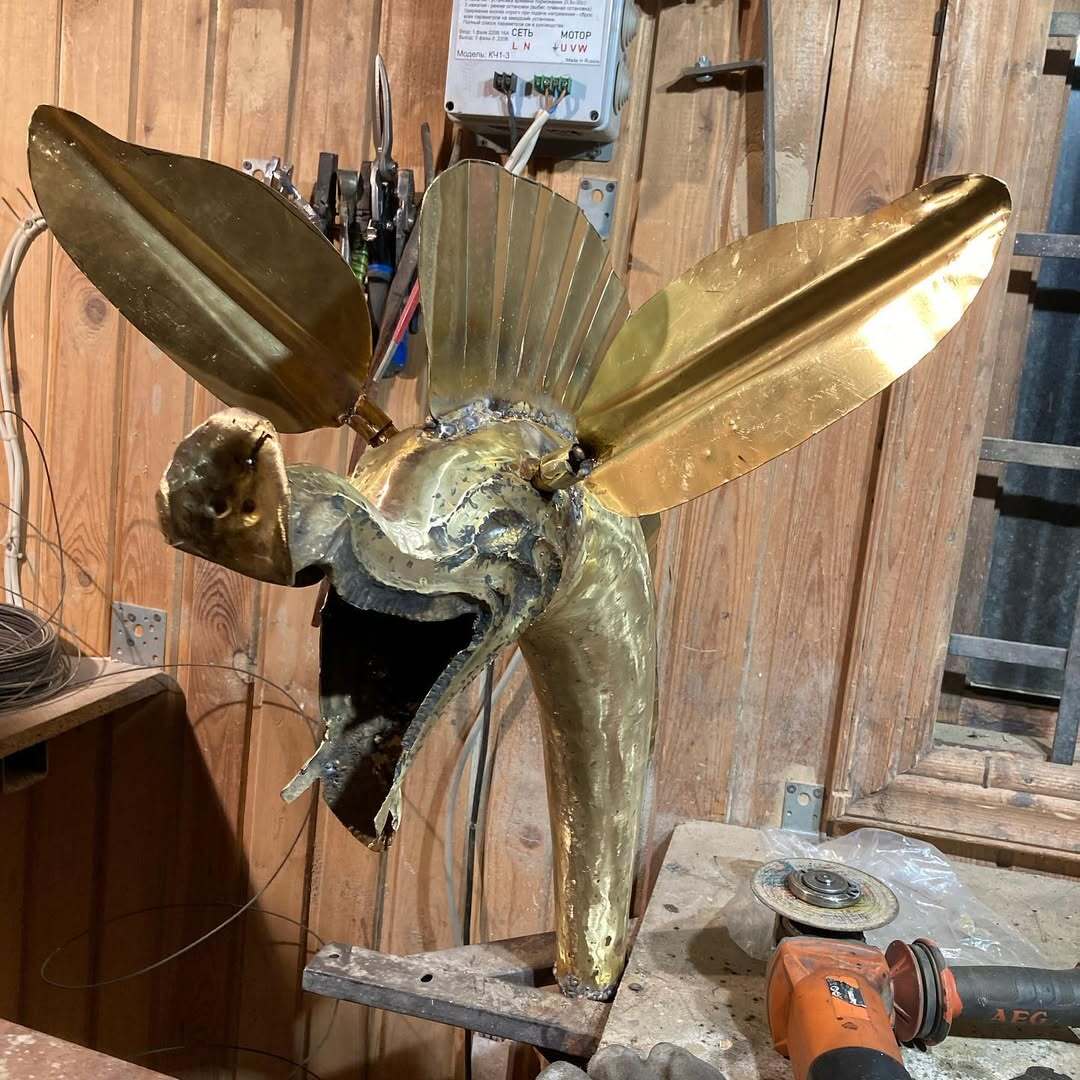
The Sensation at Tintignac. The "Cemetery of Carnyxes"
Then, in 2004, something incredible happened. In southern France, at Tintignac, archaeologists excavated an ancient Gallic sanctuary. And they stumbled upon... a real "orchestra." In one pit, neatly stacked, lay seven whole carnyxes! Imagine the researchers' emotions—it's like finding seven suits of medieval knight armor in perfect condition at once.
It was a revolution. The Tintignac carnyxes showed incredible diversity: boar heads, snake heads, creatures of bizarre design. They were in varying states of preservation, but crucially—for the first time, scientists saw not only the heads but also preserved wooden parts of the tubes and fastenings. One of the most elegant now graces a museum and has become the model for all of us, reenactors. We make the most accurate copies from it.
You'd think after Tintignac, everything was clear. But no! Literally a few years ago, during new excavations, more fragments were found. And what do you think? They found the mane and part of the neck of a carnyx that bears a striking resemblance to that old "Carnyx of Mandeure"!
It was a revolution. The Tintignac carnyxes showed incredible diversity: boar heads, snake heads, creatures of bizarre design. They were in varying states of preservation, but crucially—for the first time, scientists saw not only the heads but also preserved wooden parts of the tubes and fastenings. One of the most elegant now graces a museum and has become the model for all of us, reenactors. We make the most accurate copies from it.
You'd think after Tintignac, everything was clear. But no! Literally a few years ago, during new excavations, more fragments were found. And what do you think? They found the mane and part of the neck of a carnyx that bears a striking resemblance to that old "Carnyx of Mandeure"!
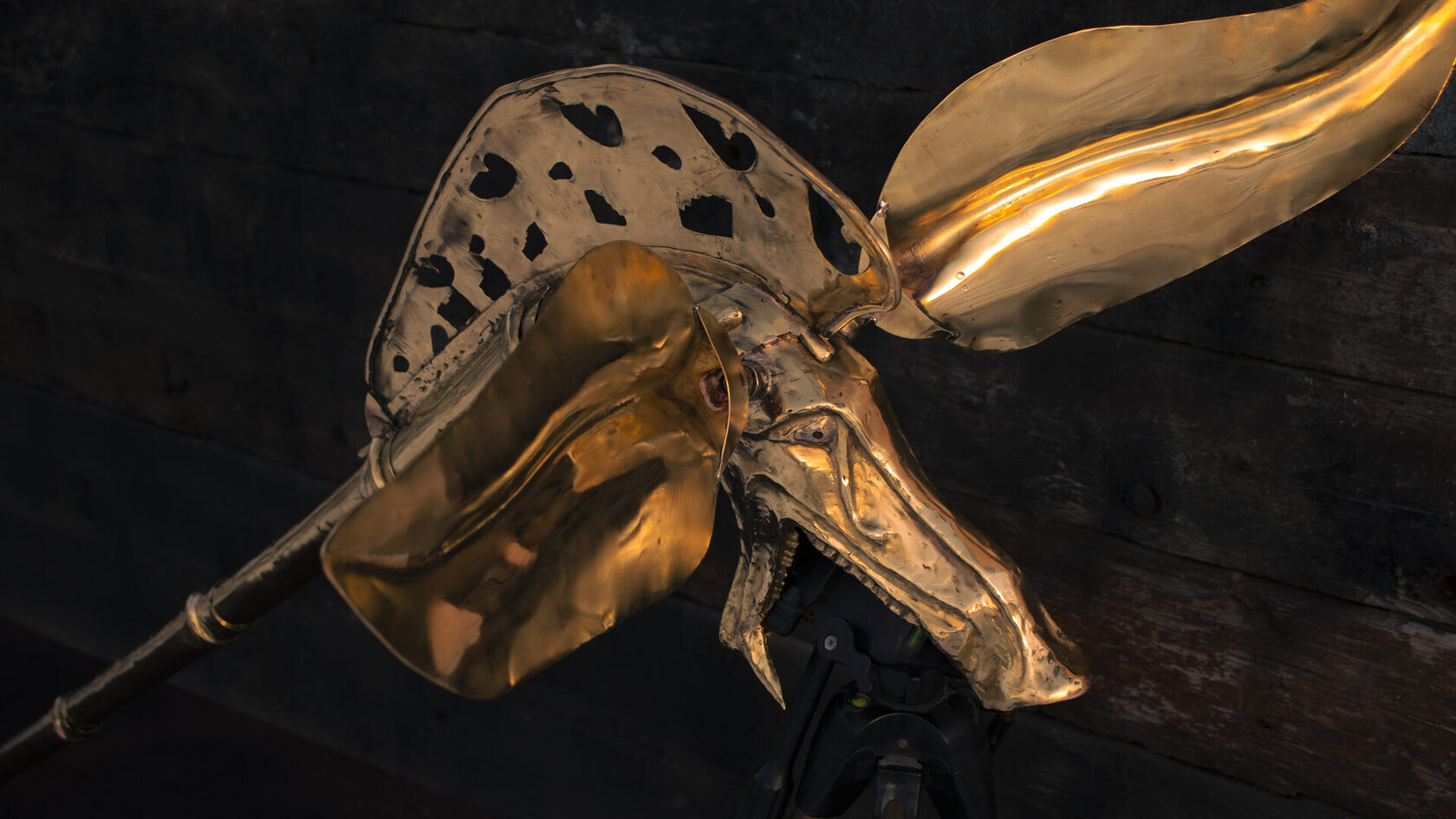
The Norfolk Hoard: What Was Found and Why Is It Unique?
The Norfolk Hoard: What Was Found and Why Is It Unique?
The Norfolk find is not a single item, but an entire coherent "votive" hoard, deliberately buried in the 1st century AD. Together with the carnyx, the pit contained:
The uniqueness of the Norfolk carnyx lies in several details:
- A bronze boar's head: presumably a finial for a warrior's standard—the first such find in Britain.
- Five shield bosses (umbos).
- An iron object of unclear purpose.
The uniqueness of the Norfolk carnyx lies in several details:
- Preservation: It is the most complete known carnyx in the world. When buried, it was partially disassembled, and shield bosses were carefully placed on top, aiding preservation. It even retains unique "large drooping ears" in place.
- Traces of a Long Life: The bronze shows signs of repair, indicating long and likely careful use of the instrument. This was not a ritual trinket, but an important, working artifact.
- Historical Context: The find location is the heartland of the Iceni tribe, the very tribe ruled by the legendary Queen Boudicca, who led a rebellion against Rome around 60-61 AD. While a direct link to her is unproven, archaeologists note that items "of such quality" would have been known to the entire Iceni elite. This find brings us closer to understanding the world in which Boudicca lived.
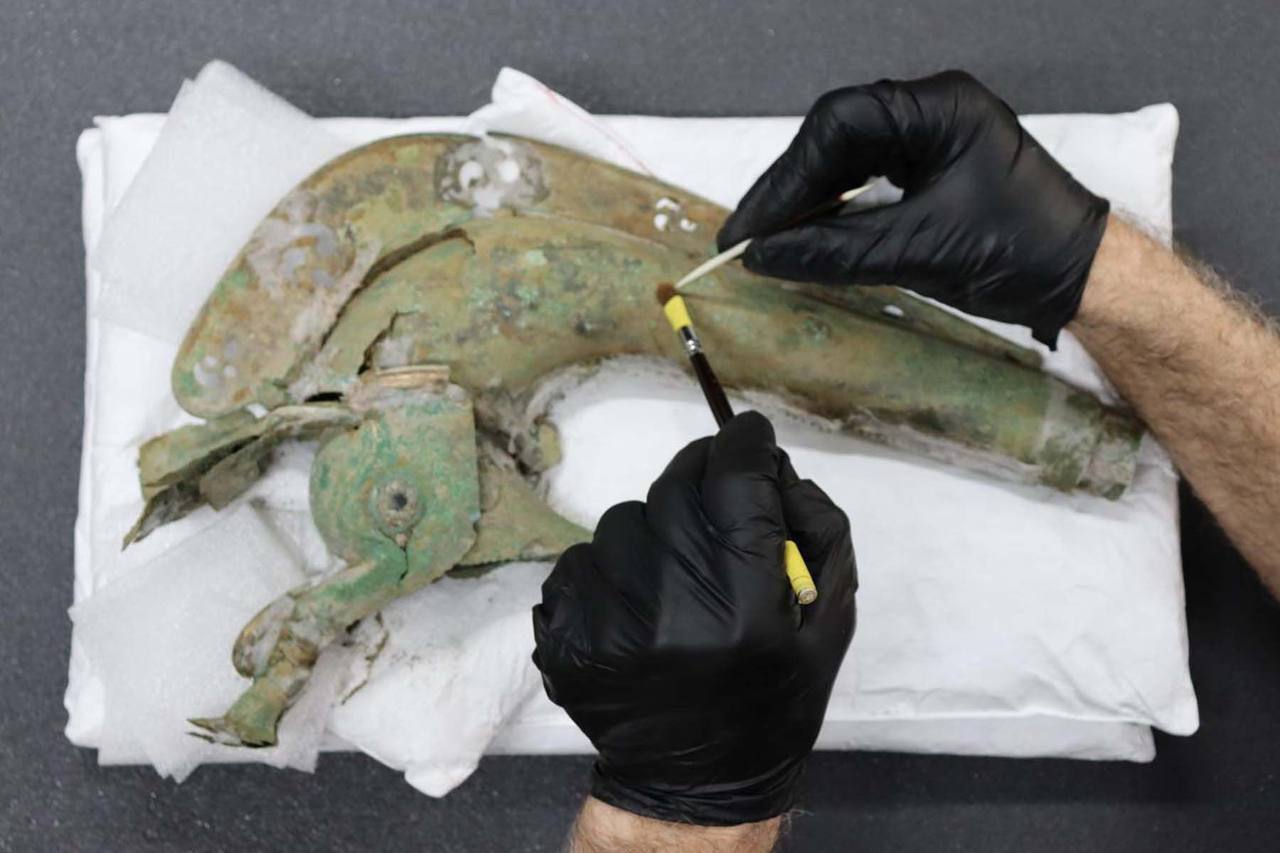
Currently, the fragile artifacts are in the hands of restorers from Norfolk Museums Service. They were extracted in soil blocks, scanned to analyze their arrangement, and now a long process of stabilization and cleaning begins. Only after this will scientists be able to study them in detail.
Fraser Hunter, curator of the Iron Age department at the National Museum of Scotland, believes this find will "radically expand our understanding of the era" and "change perspectives on the sound and music of the Iron Age." Acoustic studies of reconstructed carnyxes are already underway. For example, French scientists, studying a copy of the Tintignac carnyx, found it produced a powerful, dissonant sound, "something between a trumpet, a siren, and a didgeridoo."
When the Norfolk carnyx is restored, we may get an even more accurate recreation of its authentic voice—the very one that thundered over the fields of Britain two thousand years ago.
In the near future, a coroner will determine the hoard's status under the Treasure Act 1996, after which the question of its permanent home in a British museum will be decided.
Fraser Hunter, curator of the Iron Age department at the National Museum of Scotland, believes this find will "radically expand our understanding of the era" and "change perspectives on the sound and music of the Iron Age." Acoustic studies of reconstructed carnyxes are already underway. For example, French scientists, studying a copy of the Tintignac carnyx, found it produced a powerful, dissonant sound, "something between a trumpet, a siren, and a didgeridoo."
When the Norfolk carnyx is restored, we may get an even more accurate recreation of its authentic voice—the very one that thundered over the fields of Britain two thousand years ago.
In the near future, a coroner will determine the hoard's status under the Treasure Act 1996, after which the question of its permanent home in a British museum will be decided.
So, What Was It Really Like?
When finds are scarce, it's hard to talk about strict classification, as for, say, medieval swords (remember famous typologies by Kirpichnikov?). But trends are emerging.
We can very roughly outline two types:
This means the ancient Celts didn't have one template "for all of Europe." There were regional or workshop schools, their own traditions. The carnyx evolved and varied, like any living cultural phenomenon.
We can very roughly outline two types:
- The "Tintignac" type: A group of instruments from one place and time. They share common "handwriting" in head shape, similar tube diameters. The neck could have been composite.
- The "Mandeure" type: This now confidently includes both the original fragments from Mandeure and the new find with the mane. They have their own, very characteristic head shape and a solid neck.
This means the ancient Celts didn't have one template "for all of Europe." There were regional or workshop schools, their own traditions. The carnyx evolved and varied, like any living cultural phenomenon.
How We Are Restoring the Voice of Antiquity
When we set out to make a working carnyx, it's always a compromise between science and common sense.
Suppose we want to reconstruct the Carnyx of Mandeure. We have its head and ears (bronze originals). We have the new find—its mane and neck shape. But what about the tube? It hasn't survived!
Here, the Carnyx of Tintignac comes to the rescue. We take its tube diameter and length because they are actually found and measured. Then comes craftsmanship and an understanding of acoustics: how to flare this tube so it perfectly connects with the "Mandeure"-type neck? It's like an engineering task from our ancestors.
The result: our instrument won't be a 100% copy of any single one. It will be a composite image based on all known data. And when it emits that low, vibrating, animal roar for the first time—goosebumps.
Suppose we want to reconstruct the Carnyx of Mandeure. We have its head and ears (bronze originals). We have the new find—its mane and neck shape. But what about the tube? It hasn't survived!
Here, the Carnyx of Tintignac comes to the rescue. We take its tube diameter and length because they are actually found and measured. Then comes craftsmanship and an understanding of acoustics: how to flare this tube so it perfectly connects with the "Mandeure"-type neck? It's like an engineering task from our ancestors.
The result: our instrument won't be a 100% copy of any single one. It will be a composite image based on all known data. And when it emits that low, vibrating, animal roar for the first time—goosebumps.
Studying the carnyx is not just technical curiosity. It's a way to hear the past. This instrument was not just a "trumpet." It was a symbol of power, a magical amulet, the voice of a community on the battlefield. Each new find adds a note to this ancient melody.
And now, when you hear the sound of a reconstructed carnyx somewhere (it's increasingly heard at festivals), you will know: behind this sound stands a long detective story, excavations, insights, and the labor of many people who spare no time to return a voice to a forgotten giant.
And now, when you hear the sound of a reconstructed carnyx somewhere (it's increasingly heard at festivals), you will know: behind this sound stands a long detective story, excavations, insights, and the labor of many people who spare no time to return a voice to a forgotten giant.